
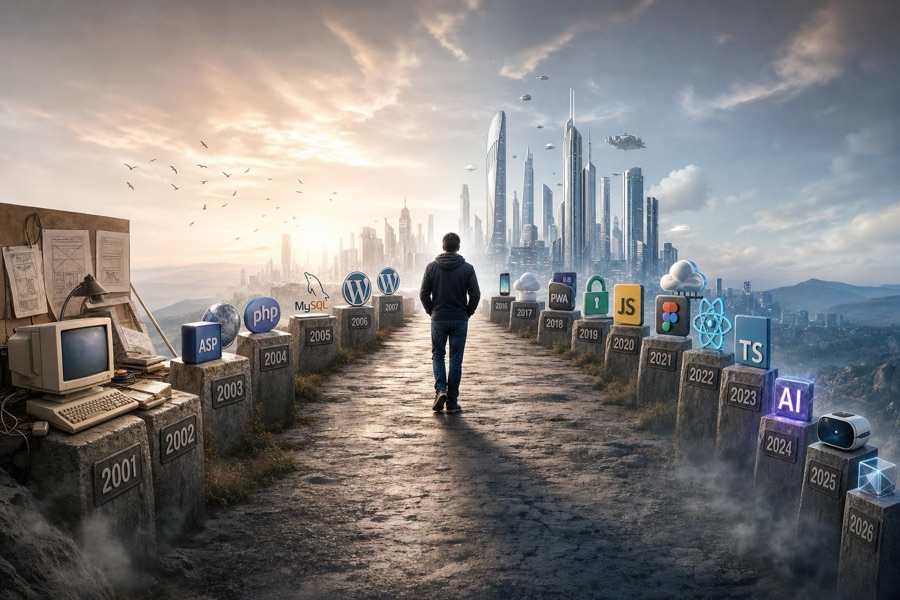
Twenty-five years of web tech, year by year
A working designer’s timeline through ASP, PHP, MySQL, WordPress, and whatever came next. 2001 to 2026.
Before the web
1984. Junior high in Irvine, California. An Apple IIc on the desk and a BASIC manual next to it. Typing programs in line by line, saving them to 5.25-inch floppies, learning that a computer does exactly what you tell it and nothing else. The web was seventeen years away, but the habit that matters was already forming: figure out how the machine thinks, then make it build something useful.
// THE TABLE ERA (2001-2005)The Table Era
2001. HTML hand-coded in a Notepad window. Classic ASP for anything dynamic. MySQL when data needs to persist. IE6 ships and refuses to die for the next decade. Tables nested inside tables for layout. XHTML 1.0 ratified.
2002. Mozilla 1.0. Movable Type blogs. Macromedia Flash is how you make a site feel “interactive.” ASP still dominant for server-side.
2003. CSS Zen Garden launches and proves you can build the same page two hundred ways with stylesheets alone. WordPress 0.7 ships and enters the toolkit as a blog install. Safari 1.0.
2004. Firefox 1.0. Gmail launches and makes Ajax mainstream. “Web 2.0” gets coined. PHP overtakes ASP for client work. LAMP becomes the default stack.
2005. YouTube. Google Maps drags the rest of the web into Ajax. Rails 1.0 starts the convention-over-configuration era. WordPress becomes the go-to CMS for content sites. Custom PHP and MySQL for anything bespoke.
// THE AJAX-AND-JQUERY ERA (2006-2010)The Ajax-and-jQuery Era
2006. jQuery 1.0. Twitter. Facebook opens to the public. The DOM gets ergonomic for the first time. WordPress plus jQuery becomes the working setup.
2007. iPhone. WebKit goes mobile. Everything changes, but most sites don’t notice yet. WordPress is now the default for client builds. Classic ASP retires.
2008. Chrome 1.0 ships with V8 and the JavaScript engine arms race begins. Android launches.
2009. Node.js. HTML5 video. Server-side JavaScript stops being a joke.
2010. Ethan Marcotte publishes “Responsive Web Design” in A List Apart. iPad launches. CSS3 transitions and animations ship. Client themes get rebuilt responsive from the ground up.
// THE FRAMEWORK ERA (2011-2015)The Framework Era
2011. Bootstrap 1.0. Sass goes mainstream. Every site starts looking the same on purpose. WordPress themes pick up a Bootstrap underlay.
2012. Retina displays. Flexbox enters the spec. Skeuomorphism peaks before falling off a cliff.
2013. iOS 7 ships flat design. React released. AngularJS rising. Component-driven UI becomes the conversation. WordPress page builders (Divi, Visual Composer) take off and enter the toolkit for faster client turnarounds.
2014. Google Material Design. ES6 specced. Web Components edge in.
2015. Vue.js. CSS Grid enters the spec. HTTP/2. The frameworks split into camps. WordPress powers roughly 25% of the web.
// THE JAMSTACK ERA (2016-2020)The Jamstack Era
2016. “Jamstack” gets coined. Netlify rising. React wins. PWAs get pitched as “the future of the mobile web.” Jamstack gets tested on a few projects; WordPress wins out for client work, because content editors don’t want a git workflow.
2017. Headless CMS goes mainstream (Contentful, Sanity, Strapi). CSS Grid ships in browsers. Service workers everywhere.
2018. GraphQL adoption climbs. Gatsby, Hugo, Eleventy split the SSG market. Webpack pain peaks. WordPress Gutenberg block editor ships.
2019. Headless WordPress. Next.js gains share. The industry collectively names “JavaScript fatigue.”
2020. Pandemic forces every business online. Tailwind CSS hits mainstream. Vercel and Netlify own deploy. The client stack consolidates around WordPress on WP Engine, custom themes, and utility CSS.
// THE AI ERA (2021-2026)The AI Era
2021. Web3 hype peaks and breaks. Astro launches. View Transitions API drafts.
2022. ChatGPT ships November 30 and the conversation pivots overnight. Tailwind owns CSS. LLMs enter dev workflows. n8n joins the stack for client automations.
2023. Copilot mainstream. Midjourney and DALL-E enter design briefs. Bun. React Server Components.
2024. Claude Code. Cursor. AI agents start writing production markup. CSS container queries finally ship. Claude joins the stack as a daily collaborator.
2025. Agent-driven workflows go from demo to production. n8n plus LLMs become a standard operations layer. Lovable and v0 let non-developers ship full apps.
2026. Where we are. WordPress is still the CMS under most client work. The orchestration around it (n8n, Claude, automation pipelines) is what’s new.
// THE PATTERNWhat compounds
A new paradigm every 2.5 years on average. None of them killed the previous one. They stacked. The stack proves it: HTML from 2001 is still in everything. WordPress from 2003 still runs most of what ships. ASP got retired. PHP, MySQL, WordPress, jQuery, Bootstrap all live on, just covered over by newer layers.
The thing that compounds across all of it is operating discipline. Year 10 of running Sonnenberg Design is built on year 25 of building sites, and year 42 of telling computers what to do. Tools change every couple years. The studio compounds.